Sunday, August 27, 2017

Hazy Horizons

Monday
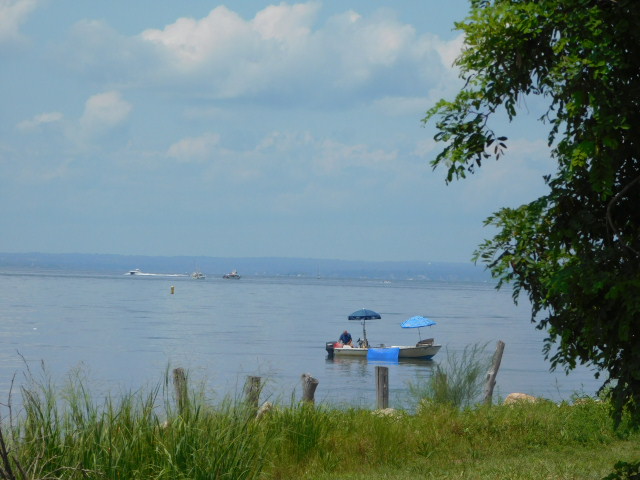
Clouds float over nearby distance, watercraft shrink with perspective, vapor blends multiple blues.
  • Any window with a glimpse of sky offers a horizon, although some are building roofs only a few yards away.  More traditional horizons are those from a mountaintop or on the beach, where the world ends in unachievable distance.  Often in August humidity is high, pollution prevalent, and horizons become lost or blurred beyond a dim bluish line.
  • Horizons naturally lead our thoughts to infinity and limits.  We perceive an immediate barrier beyond which we cannot see, but we also understand an implied universe of more beyond.   This is an interesting contradiction, contraction, tension, or summary of existence itself _ a line between known and unknown, a statement of where our normal world ends.
  • For most of us, horizons are of little more than aesthetic value.  We empty our thoughts and stare at pretty colors, perhaps picking out shapes in clouds.  We vaguely appreciate extensions beyond the vanishing points, but it is too removed to worry about.  If we are on the beach, we turn to more exciting local sights, and more immediately demanding concerns like shade and beverage and how much time is left for this particular interlude.
Tuesday
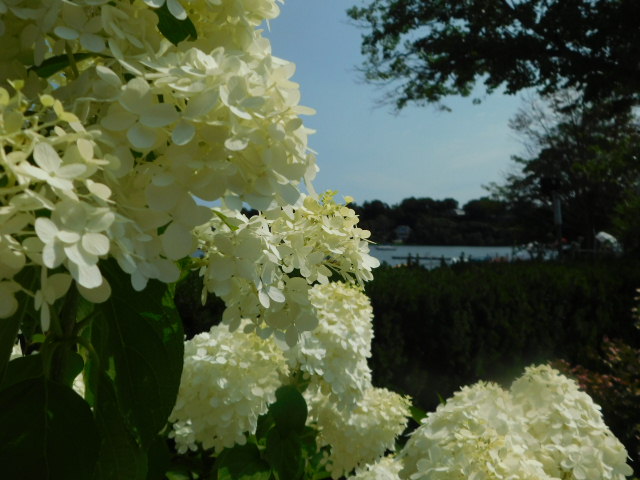
No photograph fully captures what we see; I can hardly recognize this harbor horizon as shown.
  • I’m not a bird watcher, so my normal repertoire of waterfowl recognition is gulls, egrets, cormorants, crows, ducks, geese, and an occasional hawk or osprey.  Gulls are the least intimidated of the set and often dive-bomb unsuspecting beachgoers trying to snatch a bit of food.  Sometimes they act as if they are about to become militant singly or in groups _ a minor version of Hitchcock’s classic.
  • What I enjoy as I sit is partially the unpredictable entertainment.  However the most entrancing element is demonstration of perspective.  A tiny bird down the beach or out on the waves heads towards me and magnifies immensely, suddenly looming huge.  Then diminishes quickly to a dot as it swoops away.  Reflections on how I regard my own problems _ tiny in the distance, giant when nearby _ is inevitable. 
  • Then I come to my senses, stop thinking, and simply enjoy the view, all the way to the infinitely far horizon.
Wednesday
Canoes have become rarer than paddleboards and kayaks, all welcome alternatives to powerboats.
  • Somewhere, beyond the sea somewhere …
  • Romantics experience the unknown as hope.
Thursday
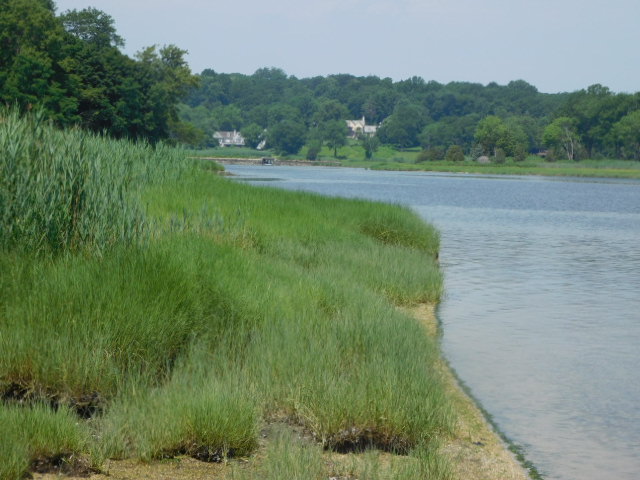
Reeds fully grown now, preparing grain seeds for next year, beautiful even though invasive in this area.
  • Thinking people have long realized the Earth is round, but everyone experiences it as flat.  The horizon is the demarcation, in this case, between logic and senses.  We may know there is something out beyond the farthest we can see of ground or water, but what is real is all about us, to be touched or smelled or used in some way.
  • Unconsciously, I think we carry this over to our perception of time.  There is an almost invisible line between now and whatever may be in past and future.  Yet we know the past contained more, and assume the future _ whatever future _ will as well. 
Friday
Late yellow flowers grab their moment and rush to seed as the frantic pace of people during summer ebbs.
  • I look across the wide water and see nothing.  Below atomic structure, immense eternal energies seethe, in tensions that eventually create the world of molecules we know.  I remain ignorant of this infinite battleground all about me.
  • I likewise fail to notice the molecules themselves _ gases and water vapor and tiny chunks of every element known to man _ drifting on the wind.  I cannot see the miniscule detritus of life such as skin flakes and bits of feather.  My eyes fail to record viruses, bacteria, pollen and tiny seeds, arachnids, and insects.
  • I stare through the soup and all that registers is that the horizon is clear or fuzzy.  All I decide is that the air is clear or somehow stained with vapor or pollution to impede my view.  My ignorance of true reality is complete, but nevertheless the horizon I do notice and the effects of the air in between are all I really need to fully exist. 
Saturday
Silver Lace Vine begins to shroud fences and neglected shrubs with a blanket of delicate white blossoms.
“Look at that beautiful sailboat,” my wife exclaims.  The sun sparkles brilliantly on crisscrossed waves stirred by an inconstant breeze.
“Sorry,” I say, looking up, “don’t have my glasses on.” 
“So you can’t see it at all?  Has the horizon vanished?”
“Oh, I see a blur.  I know something is there.  I just can’t quite make it out.”
“Very peculiar,” she says.
“Not so much.  It’s like your problem with reading.”
“I don’t see how that could be the same.”
“You know there are words on a page, for example, you just can’t quite make out the letters.”
“Oh, OK.  Well, put your glasses on.”
“I’m looking for them now,” I say.  I slip them on and the distant world jumps into focus once more.
Sunday
Glaring brightness blurs far and near, perhaps a metaphor for mindless meditation.
Perfect Shangri La I think
More lazy crazy hazy days
Far from all the madding crowd
While swarms surround me nearly naked
Contradictions fill my mind
I try escaping into breeze
And for this while, a fleeting calm
Allows ignoring outside worlds.
Isolated introspection


Sunday, August 20, 2017

August Beauty

Monday
Spicebush at Caumsett smells infinitely better than it looks, and it looks pretty good.
  • In August, I wallow in mature beauty.  Spring is crystalline promise, but late summer provides perfect culmination.  We can enjoy all possible masterpieces completed.  Early flowers may be gone, but their fruits continue to be displayed.  Leaves do not yet show inevitable decay.  Animal young flourish as they rapidly grow to prepare for winter.
  • It seems a good time to just sit back in appreciative sloth.   Of course, most times are like that for an old guy like me, but August has its own relaxing potion filled with slow flavor.  The world just is, marvelous and amazing.  A time to almost forget what it was, what it will be, what might happen.  Existence on most August afternoons simply could not be improved.
Tuesday
Centerport children’s summer camp echoes with laughter beyond the tidal flats as life goes on.
  • Painting landscapes has never paid well.  Before photographs and movies, artists were paid to either capture portraits or to provide entertaining drama (like the Sistine Chapel.)  Seascapes were either backgrounds, or thrilling illustrations of dangerous moments. 
  • Perhaps that is because it is so easy to appreciate open natural magnificence.  It hardly requires specialized training to be entranced by mountains, plains, or rolling ocean breakers.  Nature helps by allowing each of thousands of viewers at a given location to focus on a thousand different things, something for everyone. 
  • At the beach I happily gaze at sailboats along far shores, or sparkles on the wave.  My wife watches children nearby frolic in sand and tide.  When I was young, I eagerly scanned young women against the spotless sky.  Tomorrow, should I return, it will all be different.  But just as common, just as normal, just as rewarding, just as spectacular. 
Wednesday
Grasses ripen almost invisibly in various nooks along a high stone seawall.
  • A rose is a rose…
  • A rose is also several trillion cells working together to impress my several trillion cells and trillions of companion bacteria.
Thursday
St. Anne’s Lace begins the ongoing parade of late flowers which murmur summer’s passing.
  • We rush about, doing almost anything to prove we have existed.  Take a photo, talk to someone else, build or wreck something around us.  Industrial culture is a culture of doing.  Dig a ditch, fill it in.  Prove your day has been well used.
  • I’m not completely sold on frantically merchandised varieties of meditation, but anything which slows us down is a good idea.   Just as important are attitudes which allow us to feel accomplishment without affecting an external artifact.
  • I spend more time sitting and looking deeply, pause for a moment to engage with a bee or flower or cloud.  Stop in the middle of a meal or a walk to appreciate my exact point in being.  The young laugh and claim I am making a virtue of necessity.  Perhaps that is so.
Friday
Perennial Hibiscus amazes us each year with such grand reward for so little garden effort.
  • There are many kinds of snobbism, as varied as people’s beliefs.  Some, for example, dismiss cultivated flowers as less impressive than native ones, no matter how they look.  Others refuse to enjoy anything which is too common, or too easy to enjoy.  “Oh,” they exclaim, “that’s just a cheap variety of red rose.”
  • A newspaper story recently queried some “floral professionals” on flowers they claim to hate, and as might be expected, the answers were always common flowers that everyone else loves most.  How otherwise could they maintain that their own expertise is valuable? 
  • But I love whatever blooms I can find this month, after the midsummer annuals have gone to seed.  If the hibiscus and rose of Sharon and geraniums march on in brilliant beauty only with human help, I am content.  It is just as much a mistake to pretend people are not part of the environment as it is to ignore our environment entirely.
Saturday
Marigolds compete with kayaks on our misty public beach, a scene which will probably vanish within twenty years.
Shadow from a hulking twitchy young man falls on a woman lounging back in a beach chair.  Gulls fight for bread which small children throw at them.  “Hey Mom, doing nothing again, I see,” he laughs roughly.
“Ah, Justin, this is just so beautiful and perfect.  You should try it sometime …”
“Waste of time, beauty, What good is it?  What is beauty anyway?”
“Deep questions from you?  I guess college has broadened your mind more than I thought.  You guys get into heated discussions like this over beer at the bar?”
“Not hardly!” he exclaims.  “But we have one teacher … Anyway, I’m sure you can’t answer the question.”
She thinks a moment.  “Well, whatever it is, I think it requires variety and change.  And people.  You’ll never convince me a bird or dog experiences beauty.”
“Is that all?” he snarks.
“Enough.  Anything more just gets muddy.  But this, right now, is beautiful.  Now, Justin, you sit down right here and tell me everything that is happing with you.”
“Aw, Mom.”  In resignation, he flops on the towel next to her and begins his story.
The gulls flop off to panhandle further down the sand.
Sunday
Fish clustering in thousands at head of harbor presumably trying to advance up streams that have been dammed.
August moon fills harvest songs
But now we harvest all year long
Summer sand and beach once rare
We visit year round through the air
I take for granted all my days
Hardly note late summer haze
My mind as emptied as the sky
August simply rushes by


Sunday, August 13, 2017

Firmly Middle

Monday
Ho hum, just another pleasant view on another normal day, nothing to be excited about, unless I am alive.
  • “Jack of all trades, master of none” is the pejorative version of “renaissance man” who is, presumably, master of everything.   A renaissance person is now conceptually impossible even for an immortal _ who could possibly know nor use all the knowledge that has accumulated over time?  We could, of course, select categories _ a master flute player who is also a Nobel physicist and industrial tycoon _ but even the most outrageous of such fantasies ignore all the rest of human possibility. 
  • So the common wisdom is to give up breadth and simply be the best at some specialization and let everything else fall as it will.  I think this is a disease of our culture, not merely in careers but also in daily life.  Folks who narrow themselves into pure categories to fully enjoy the essence of perfection are giving up a large part of the simple joy of being.  It is possible, for example, to enjoy wine or food without becoming a connoisseur of vintage and cuisine. 
  • Perhaps time spent in carefully cultivating nuance could be better utilized for modest appreciation of other worldly miracles.  We resist this thought because then we would simply be one of the crowd, like everyone else, and this culture pushes hard to terrorize us about not being uniquely worthwhile.
Tuesday
Rose of Sharon, like goldenrod, is an early reminder that summer is slipping away quickly.
  • Darwinism has been twisted into all kinds of pretzels to explain and justify almost anything.  “Survival of the fittest,” which is a perversion of “natural selection” attains the status of holy writ.  We automatically think of “biggest” “best” “most agile” “best adapted.”  Of course, most of the really specialized magnificently focused species are evolutionary dead ends, and die when their environment changes.  Like some job categories these days.
  • Consider our most successful evolved companions _ mosquitoes, cockroaches, rats, bacteria, fungi.  Hardly specialized.  Mosquitoes are pretty pesky things and seem not to care too much about which blood they feast on.  If a particular bird species dies out, mosquitoes don’t starve.  We should recognize that like them, we are happy generalists, and it is our lack of specialization _ not our ability to focus narrowly on problems _ that provides us true freedom.  
Wednesday
Under billowing overcast skies, water grasses dance delicately amidst reflections and shadows.
  • Anything worth doing is worth doing well.
  • But perhaps “well” should be defined as “just good enough.”
Thursday
Abstract light and dark form phantom compositions only my mind might notice.
  • Everybody wants to be special, we are told.  It’s a pillar of social control.  Blue bloods always preach that they are in charge for a reason, even if that reason is simply that god or fate has been on their side.  Lately they claim they are smarter.  It’s always a justification for why they have more and everyone else has less.  Once upon a time their needs were insatiable, but now there is a bit a trouble as all needs have generally been overfilled.
  • At this point, elites sprouting ever more plumage look like sickly extremes of a genetic bell curve.  How many pretty (expensive) tail feathers can they display?  How does that make them more fit? 
  • Humans do not generate peacock feathers or saber-tooth fangs.  Our singular adaptability for survival is our individual mind and our social skills, which we can adjust internally.  Being happy with what we have, at least in an affluent society, may be a better survival strategy than frantically and neurotically racing to be at the head of the pack.  
Friday
Vegetation reaches its peak, in this greenest summer in memory.
  • Seagulls seem to be among the least specialized birds, or perhaps they are simply the best adapted to human environments.  When other avian species that none of us ever encounter vanish, seagulls will still be around.  Like most animals that exist near humans, their specialization is that they have none.
  • As our current culture evolves, I believe our current high-strung never-sleep desperate patterns will self-destruct in either chaos or burnout.  As machines replace all the necessary slavery of the agricultural age, the apparatus of that era _ which has now run amok _ becomes useless.
  • I like to believe that our descendants, if any, will be more like seagulls than cockroaches.  Flying free, always finding enough, enjoying mock crises, and strutting independently or riding tides peacefully however and whenever they wish.
Saturday
Colors hinting at autumn are beginning to creep into leaves here and there.
“Lurk, you’re looking a bit thin these days.”
“Yeah, Vlad, I know.  The trouble is I think I’ve developed a bit too fine a palate.”
“Not sure what you mean,” whines Vlad, hovering as he scents the air for stray carbon dioxide trails.
“Suckella dragged me into a fine blood tasting event, last week, and I discovered I was able to tell the difference between various samples.  Fish, for example, is awful, and bird’s just cheap.  Humans vary an awful lot but a few are simply delicious.”
“Ok, but what …”
Lurk holds up a few of his six legs.  “Hear me out … The fact is the only food I can stand right now belongs to that sweet littlest child that comes out only once in a while.  I’ve been waiting for days now, but I’m still not hungry enough to go back to _ ycch _ bird.”
“But there’s a big guy now!” yells Vlad, whirring in excitement.  “He won’t even notice me under his knee until I’ve  finished the feast.  Why don’t you try his forehead?”
“No, no,” sniffs Lurk, pretentiously.  “Common sour stuff.  I’ve tried it before.  No, I will just wait and hope.”
“Suit yourself,” says Vlad, zipping off, as Lurk alights on a nearby hemlock needle.
Neither could comprehend the big human when he called to his mate “I hope little Sue Ellen has a great vacation upstate.”   It’s doubtful Lurk will survive the week.
Sunday
Flooded marshes gradually recover from centuries of being channeled, drained, and harvested.
Middle is infinite.
Around, below, above, within, without
Extend endlessly.
The farthest is too far.
Deepest is too deep.
All directions are pursued futilely.
Middle is perfect.


Sunday, August 6, 2017

Liquid Trance

Monday
Low tide quietly lapping on exposed spartina grass.
  • This time of year, depending on tide tables clouds and heat, we often grab towels and head for a local beach on Long Island Sound.  Retirees doing nothing at all to help the planet.  On the other hand, we are not aggravating it nor anyone else.  The waves roll in, sparkles fill the wide bay to dark trees on the far shore as randomly placed boats glide or race about.
  • Waves flow hypnotically.  All identical, each unique, close to eternal.  They have rolled onto similar sand and pebbles and rocks since the oceans formed, billions of years ago.  Well before life, they were cresting and swishing.   No matter what happens to life from here on they will continue until Earth itself ends in barren cold or fire depending on the type of death of the sun.
  • Watching them easily fills an hour or more.  Pure mindless meditation, no possible meaning, no logic, simply being.  It looks like there is a pattern, but that too is illusion.  Blink eyes and everything might appear totally different.  I accept this pleasant trance and feel my soul being restored.


Tuesday
Almost dizzy just trying to make sense of this.
  • If mosquitoes are not too thick, chased by moderate sunset breezes, we sometimes sit and watch the sun _ the bloody sun in most travel literature _ slowly drop below the horizon, outlining trees on hills rising above puppy cove.  Rather than becoming blinded by staring at the direct spectacle, I concentrate on the constantly moving abstract spectacle of reflections and colors on the water’s surface.
  • We could claim there is no art here, for there is no human creation.  But I am involved, so I represent the human element, the artist who chooses what to see as well as the audience who appreciates what the artist has shown.  Perhaps it illustrates how complicated the idea of art may be … but then I am drawn back in, watching distortions and sparkles and sudden patterns that mean everything and nothing.  The dominant colors change with the minutes, and finally the glow dies and we scamper back as tiny thirsty creatures of the night regain their territory.
Wednesday
Just back from Rochester, where the high falls are full following months of plentiful rain.
  • What a day for a daydream.
  • What a moment to consciously appreciate
Thursday
Canandaigua, one of the finger lakes, provides a slightly different aspect of water meditation.
  • I wish to praise stages in life, which is hardly in fashion any more.  Infants are preplanned into trajectories before they leave the womb, children are prepped to be adults by hovering parents, adolescents fear permanent failure if they stumble.  And then each individual fights a long slog of conflicts while trying to pretend they are growing better and not older until the day they die.
  • Perhaps it is better to try to accept the wonders of our changing condition.  An infant is potential glory, but also a miracle as itself.  Childhood should if possible be a time of play and joy and lack of responsibility,  adolescence should be carefully matured with grandiose dreams, young adulthood should be a time of excess and exuberance, later adulthood through middle age a time of mastery and accomplishment.  And finally accept later years to retire to a life of contemplation and providing advice. 
  • Once upon a time such a route was a worthy goal, for those fortunate enough to live past forty or fifty.  One of the aggravations of our current culture is the belief that each unique individual must freeze identity from year 0 to 100.  
Friday
As temperatures climb into humid high nineties, an excursion to open water more inviting than a woodland hike.
  • Classic movies show the bows of majestic sailing ships cleaving water smoothly and quietly, perhaps encouraged by surfing dolphins, while wakes roll out from ponderous sterns.  Such wave actions are less prevalent along our shores, more likely to catch high chops from racing cigarette boats, all sizes of pleasure cruisers, and speeding jet skis.  The tiny perturbations of small sailboats are lost in wind crests.  And the gigantic swell of tankers or freighters passing along the sound vanish into tidal rhythms.
  • Even the momentary surface appearance of such bodies of water is so complex as to be frightening.  And that ignores what really happens beneath and around _ huge volumes and actions nobody can truly appreciate.  But the surface is what I see _ spray and sparkle, roll and whitecap, infinite, eternal, transient, momentary, and only meaningful this second because I happen to be looking at it.
Saturday
Reflection perception presents multiple puzzles to be solved by how we focus.
Water, Air, Sand and Rock are discussing permanence with the Sun.
“What are you talking about, Water,” asks Sand.  “I keep my shapes a lot longer than you do.”
“That makes me laugh,” snorts Rock.  “I’m here millions of years, you know.”
“I’m around forever,” claims Air.
“Nobody sees you, you don’t do anything, wind lasts less than Water here,” replies Sand.
“Well, so have I, in that sense,” says Water.
“Children, Children,” calls out Sun.  “We all have our own times and moments, all the same, all the time.”
“What?”  they chorus.
“It’s only those pesky humans who notice time,” Sun tells them.  “My billions of years, Rock’s millions, Sand’s minutes, Water’s seconds, Air’s moments _ all the same thing to our way of being.  It’s only those foolish people who live in time.  We just are, forever.”
Unknowing.
Sunday
Amazingly we can easily separate reflections from objects to make sense of our jumbled visions.
Swish in, flow out, ripple, reflect, lie still
Immerse myself in great floods outside
Conscious of larger ones within
Attempt full awareness
Calmly accept
Impossibility


Thursday, July 27, 2017

Sultry Apathy

Monday
Still waters and my own mind almost as tranquilly empty as the calm moist air following overnight showers.
  • Each day brings tales of the aspirations of important cultural players.  People who are elected, appointed, anointed, or who make more than the average Mr. and Ms. Jones.  They have rigid ideas about what you and I should be doing, and how they will force us to do it, to make us more like them.  Except of course they do not want us ever to be actually elected, anointed, etc. etc.
  • I never could quite work up envy.  I believe those minds are closed to the truly finer aspects of existence.  Summer happiness has fortunately soaked away even minor irritation _ I sit on a beach or walk the woods immersed in beauty and meaning and constant joy.  Apathetic, I wantonly ignore where such self-declared leaders imagine they are steering society.
Tuesday
Deadly nightshade tangles along the road, glistening with imagined malevolence based only on its name.
  • What better place to contemplate reality than a warm sandy beach on a hot summer day?  I riffle through a thick book, periodically glance up at boat traffic piloted by those too juiced to relax, listen to laughter and screams of children, watch a few others just like me.  Almost all of us, surprisingly, fully untethered from the electronic web which tries to make our lives so insistently worried.
  • This lethargy does not help our GDP.  I’m using public space, spending no money, directing nobody else to do some chore for which I will pay them.  I might as well be an ancient ancestor lazily contemplating our universe in between chipping stone hand axes.  I guess I should feel shame while shirking the necessity of constant intrusive progress.
Wednesday
Chicory lovely blue blossoms before noon,  brightening a chill moist stroll.
  • The busy bear went over the mountain …
  • Maybe he should have spent more time examining his own.  
Thursday
Quasi-professional clam bayman gets ready to try his luck beyond the inlet.
  • There is a dawning realization driven by current economic conditions that the United States in the 1950s was in many ways a golden era never likely to happen again anywhere.  At the time and in decades of later mythology it was seen as the normalized dawn of utopia.  Science could cure all ills.  Jobs would constantly become better and higher paying.  There would be time for recreation, second homes, infinite wealth.  And people would become good and make the world perfect.
  • It all felt that way, of course, because at the time the US was a uniquely undamaged industrial state, and moreover had just gone through a few traumatically unifying events (the depression and WWII).  Theorists and leaders have sought to maintain or recreate that for years.
  • For me and my boomer peers, such was normal life.  What happened, we keep asking.  Where is utopia now?  High taxes?  Government deficit?  We easily forget that in the 50s taxes were extremely high, especially on the wealthy, and industry grew anyway.  The government spent money like water on the interstate highway system, ballistic missiles and nuclear weapons, and countless other projects and the boom went on with no end. 
  • The dream of the 50s has turned into the curse of our times, and has broken society into brittle little pieces absolutely certain that everything has gone wrong, and somebody must be to blame.


Friday
Summer blues surround pale bindweed blossoms,  pretty enough here, an alarming menace in my garden.
  • Summer has returned as I melt here on the patio.  High humidity, lots of insects including mosquitoes but mostly during the day just various harmless insects.  Birds visiting the birdbath and feeder.  Flowers wilting, and me happily dripping as I read some interesting new work from the library.
  • We have been visited by frequent intense storms, so many and so often that we wonder if global warming is part of the reason.  Birds and flowers don’t seem to mind, but we worry.  There have been storms before, high heat before, but …


Saturday
High eighties, burning sun, no breeze, a fine day for fishing even if nothing bites.
Two older folks set up chairs on pebbly beach, inhale deeply of salty breeze, stretch in hot sun.  One turns a radio low volume to an oldies station.  The other looks around, surprised.
“Eddie?” asks the woman.  “Is that you?  My God, haven’t seen you in …”
“What?” He squints and blinks.  “Oh, hey, Brender.  Yeah, been a while.”
“Where you been, anyway?  Surely we should have …”
“Well, been living on the West Coast since forever.  Just visiting a trade fair in Melville.  Thought I’d look in on some of the old places, see what’s changed.”
“A lot and not much, same as everywhere, I guess,” Brenda smiles.
“You certainly seem to be doing well,” laughs Eddy. “Still looking pretty damn good.”
“Why, thank you, sir.  And you as well.  What you been up to?  Jeez, what is it _ 40 years on?”
“Yeah, I think … summer of 75?  Me, I’m just killing time until retirement, a few years from now.  Selling pools, actually, at my father-in-law’s place.  I hate it, but college for the kids you know.”
“Ah, how many?”
“Two girls.  And you?”
“Good, good.  Stopped work when I had my knee replaced last year.  Jack still covers everything, and I have Heather living down the street with her kids, so I babysit a lot.”
“A lot happened after those highs and lows back then, eh?” smiles Eddie.
“What we didn’t know …” replies Brenda.  “I remember thinking it was the end of the road.”
“Both found a way to survive, though,” he notes.
“Survive hell, I’ve had a blast.  Still enjoying myself.”
“I see, I see.  Yeah, me too.”
They sit back carefully and begin to stare out at constantly sparkling waves as white sails outline against the far dark hills.  The radio tune has run its course, tale frozen in time,  but life continues to unroll and complicate and surprise everyone.
Sunday
Except for crowded boats in distant marina, this could be a scene from sixty or more years ago.   
Molasses summer, vast and free
I rest unbodied, drift in time
While insects flit, some bother me
Break concentration on this rhyme

Where should I go, what must I do
Or simply sit as life spins by
Quite content my lassitude
Let others preen or sell or buy

My years are flowing rapid gone
I’ve loved each one, and still admire
Achievements, memories, every one
Wish little more, from this retire.


Sunday, July 23, 2017

True Olds

Monday
Egrets enjoy a light meal on tidal flats in rising heat.
  • “News” should be naturally opposed to “Olds.”  The sun came up today, I am still alive, the world is full of marvels _ these are not news.  When the sun remains dark, if my arm aches, any unusual event anywhere _ these are supposed to grab our attention as curious primates.
  • Fake news is the current meme, which some call lies.  But it really stands for irrelevant entertainment that has no bearing on our daily life.  Can I affect a dying sea otter population on the far side of the world, what does it mean to my daily action today, how does it help me survive better?  Honestly, most news from our vast media sources is useless to how each of us lives.
  • The olds are good and bad.  The climate degenerates slowly, but the environment temporarily at least remains vibrant.  My trillions and trillions of cells are still miraculously working well to support a consciousness, although perhaps less vibrantly than forty years ago.  I am now spending a lot of time trying to appreciate the olds and to be less concerned with superficial novelty.
Tuesday
Intimations of late summer as dock shines reddish brown in shimmering heat.
  • This morning’s olds is that there are lots of chipmunks in our area.  News is that we have two in the back yard taking advantage of sunflower seeds falling from the bird feeder.  Cute little things, and probably this year’s crop since they show too little concern for big creatures like us lurking about.  Fun to watch, even though we are quite aware that they carry ticks that spread lyme disease.
  • If our chipmunks vanished, the olds would not change at all, although the news might distress us.  If all the chipmunks in our area disappeared, or if, like that bats, all of those on the North American continent were threatened, it might be a different story.  But it is so hard to tell which is which, and most of the time the news we are aware of is of our purely backyard type, from which no conclusions are possible nor valid.
Wednesday
Some public beaches in Huntington can occasionally resemble deserted Caribbean isles in travel brochures.
  • A bell clangs in the night: “2017 and all’s well.”
  • Not quite.
Thursday
Smog, beauty, bright leaves, shining water, and artifacts of our civilization everywhere.
  • We like to believe that our culture is changing more rapidly than any other in history.  The jury on that is out, I have seen studies claiming the 14th century in Europe was even quicker.  Certainly the “long static unchanging lives” which some people tell us happened long ago have never been true in “civilized” places for the last two thousand years.  In all that turmoil, survivors mostly contended with “olds” _ getting food, shelter, clothing, and following the routines of normal life. 
  • What has been true, and continues to be so, is that our local lives are affected by distant events over which we have no control at all.  It might be technology, or war, or plague, or simple bad luck, but something we dread may be coming over the horizon every morning when we wake up.  Such news is too often bad.
  • That jars our explorer and pioneer myth.  Explorers and pioneers, by definition, left the cozy confines of routine old life and set out into a wilderness where they controlled everything that happened to them.  They ignored everything else and took care of everything that came along.  Each moment became a form of “news.”  We wish to retain a spark of such rebellion.
  • Each morning, like molasses, we are embedded in the “olds”, which is a good thing.  As soon as we power up our electronic devices, shrill salespeople try to convince us that mostly irrelevant “news” is somehow important to what we do next and how we will think this moment.  Most of the time it is wise to ignore such chatter, and deal with normal local reality.
Friday
Forgotten except by birds, entangled deep in poison ivy and thorns, wild berries ripen with hidden beauty.
  • Weeds are particularly good examples of the news cycle.  Normally, we never notice them.  They are just roadside greenery, or more leaves in the garden, or once in a while an unexpected flower.  Sometimes we even take notice, for a moment, that they help define the landscape, such as when ragweed looms waist high where there used to be hard-caked dirt.  Who cares about the growth of weeds, anyway _ they just take care of themselves.
  • But once in a while I wander around our flower gardens in July, and suddenly I am amazed to find that weeds have been overtaking the carefully cultivated displays.  Bindweed strangling the taller plants, pigweed carpeting the ground, the tentacles of crabgrass grasping everywhere, and all kinds of unknown interlopers grabbing nutrients, water, and sunshine.  On that day, at that hour, weeds are news, and I become consumed by pulling them out and clearing what should be a nice civilized space.
  • For a few days I watch vigilantly, and tug something else here or there.  And then time passes, the flowers are pleasant, and once again I notice nothing until some other morning ….
Saturday
Early light, quiet breeze, an almost false tranquility as birds chorus loudly.
Old Man River and Father Time recline on a crimson cloudbank, casually contemplating a possible game of checkers as they sip their craft beers.  Athena bounds in, glowing with enthusiastic happiness.
“Hey, you guys should get out in the sunshine.  Dianna and I just saw the most amazing deer racing by, and all the summer flower fields are too beautiful to believe.”
“Seen it all,” says River, slowly.
“Every year,” adds Time with a slight croak.
“But you’re missing it all.  Why the butterflies alone are …
“Been there, done that,” replies River.
“Year after year,” grunts Time.
“Old news,” they chorus together.  “We just want to sit back and relax.”
“Stupid lazy old men.  I think you have entirely wrong approach to the miracles of the day.”
“Moments are just moments, we hang out for eternity.”
“So do rocks.  Lot of good it does them.”  Athena flips around and bounces out and over a billowing cumulus, dwindling as she slowly falls.
“Silly whippersnapper.”
“No sense at all.”
Sunday

Last willow standing along our harbor road shimmers in early misty sunbeams.
North wind cools, south brings warmth,
East wind chills, west drives rain
Big thunderstorm always unexpected.
Born, live, die, each constant fate
isolate, enmeshed as well
Not to know deep what nor why
(unless escaped to insane dream.)
Each moment new, each memory old,
Unbalanced hopes and fears
Constantly surprised


Sunday, July 16, 2017

Northeastern Lights

Monday
Humidity dims distance, as usual heat clouds pile up along Long Island Sound over the far shore.
  • Surprisingly, as twilight lingers into short nights and late darkness, I become more aware of the moon, stars, and lights in the heavens.   Milder temperatures encourage me to pause a while when I take out the trash, and to look overhead.
  • Of course, there are few stars to be seen, around here.  When the night is absolutely clear there is the moon in its constantly changing phase, if it happens to be overhead in its complicated journey.  And a few of the brighter stars from the few constellations I remember.  Then it is almost a game to pick out Venus, Mars and Jupiter from hordes of approaching and departing jet aircraft. 
  • Writers use terms like velvet black.  Huntington skies are always an orange glow.  Town and increasing suburban electric illumination reflects back from clouds and vapor, so much that no night is truly dark.  There used to be only dim porch bulbs on houses, but now harsh security beacons either blind constantly, or switch on at every momentary sound and motion.  Cars blaze along each few minutes, actinic blue in front, trailing flaring crimson.  More and more, annoyingly tiny twinkles of solar-powered junk line walks and driveways. 
  • All of this, all the time, and only I seem to notice, for nobody else is usually outside.  The final rays breaking charm of dark evenings are multicolored flares emanating from windows where huge screens provide something to look at which is more interesting than moons, planets, and stars.  
Tuesday
Clear air all the way to low satellite orbit,  too early for much smog.
  • Volcanoes, pollution and _ presumably _ massive asteroid strikes create spectacular sunsets.  Turner’s exotically flamboyant paintings, once thought the product of an overactive imagination and exaggerated romantic senses, were recently reevaluated and declared quite realistic based on the documented effects of the massive 1815 Tambora eruption (which also caused the “year with no summer” in New England.)
  • Huntington is graced with marvelous sunsets lacing and luminescing through the soot, gasses and general industrial activity of New York City immediately to our west.  Once in a while an inversion will extend contaminated air all the way to our part of the island, but mostly we know it by its evening sky signature.  As with all such phenomena _ oil sheens or explosions come to mind _  awful causes can have beautiful effects.  
  • I would be foolish not to enjoy them.  “Taking time to watch a sunset” is a cultural meme.  But I would be amiss not to realize that they are the result of a high price we are paying to allow our civilization to continue its ways.
Wednesday
Beach roses are infallible markers of warmer days when a dip in salt water is a perfect experience.
  • Hey diddle diddle …
  • If the cow tried to jump over the moon these days, it would probably bump its head on a communications satellite.
Thursday
Last evening’s thundershowers are boiling off to form interesting patterns soon cleared away by sunshine.
  • For the last two centuries, it has been almost impossible to take a panoramic photograph without catching at least a few of the poles and wires on the horizon or nearby overhead.  Poles and wires are a definitive marker of this culture, which future archeologists can probably use to identify this particular layer of civilization in their digs.   They are so common that we unconsciously filter them out of sight, so that we are frequently disappointed when our carefully composed pictures end up being spoiled by lines and blockages we didn’t really notice at the time.
  • I can’t claim that such ruin the skyline.  They are just there, and frequently have a complement of birds sitting high up, and don’t block much of what I want to see.  But surprisingly often they put the lie to some composition that tried to capture nature at its raw best.
  • In the future, solar and other local technologies will probably make them obsolete.  Already, many thick cables and their supporting structures are dinosaurs.  Massive imposing beasts, soon to be vanquished by off-the-grid solar power and invisible airwaves.  Undoubtedly in some future parkland or designated city area they will be as carefully recreated for historic nostalgia as gas lamps and cobblestones are now.
Friday
Pollution welds sky to sea as Connecticut shoreline vanishes.
  • Dawns are different, for me at least, than sunsets.  For one thing in the summer I’m rarely awake in time for them, certainly not dressed and outside.  For another, leafy trees to our east hide direct beams until around nine or so.  By then, if the weather is warm and dry, I can ditch this computer and eat out on the patio dressed in pajamas while waiting for my wife to wake up.
  • Morning sunlight is usually clearer than that of the evening.  Eastern Long Island has less factories than exist to our west, and local pollutants have temporarily settled down.  Bright sunbeams set off brilliant blue sky, while birds proclaim their supposed mastery of the air.
  • Mornings are another part of Northeastern Lights, even when we have fog and mist.  Dew often sparkles back fractal reflections.  Cobwebs trace amazing patterns.  Sharp shadows cut around me.  Maybe it is all only so surreal because this time of day I am fully awake and aware.
Saturday
Deceptively tranquil puppy cove, like everything connected to troubles of our wide world by wind and tides.
Somewhere, physicists maintain, in impossibly infinite mathematical spacetimes, Prometheus and Orion are arguing about our night time skies.
“It’s all your fault, Prometheus,” Orion complains bitterly.
“What have I done now,” Prometheus sighs.
“Nobody pays attention to me any more.  They can’t see me,” replies the constellation.
“And that’s my fault?  Why?”
“Gift of fire, remember.”
“They don’t use fire much, and certainly not overhead.”
“Yeah, but it led to technology and now look at this place.  They can’t see anything any more except their own nocturnal pollution.”
“Not fair, that.  You might as well blame Vulcan for letting them learn to chip rocks to make stone-age tools and expand their brains.”
“Well, yeah, but you owed me after I rescued you from that stupid boulder you were chained to.”
“OK, I’m sorry.  I admit it was a mistake.  The rest of the planetary ecology has been raking me over the coals as well.  Guess the Gods knew what they were doing when they punished me.”
“Ah, it’s all right, I guess,” says Orion.  “After all, humans took care of the Gods themselves some time ago.”
Sunday
Solitary clammer tries his luck on Oyster Bay, hard work in hot conditions with a beautiful view.
Bright light night, such easy rhyme
Freely used by poet scan
Always a part of each day’s time
They think that all will understand.

But night is gone from human ken
Banished by electric flares
What was once feared is now ignored
Day or nighttime, no one cares.

Most ignore Northeastern lights
There’s better things to see
I’d cast aspersions on my peers
Except they’re just like me.